
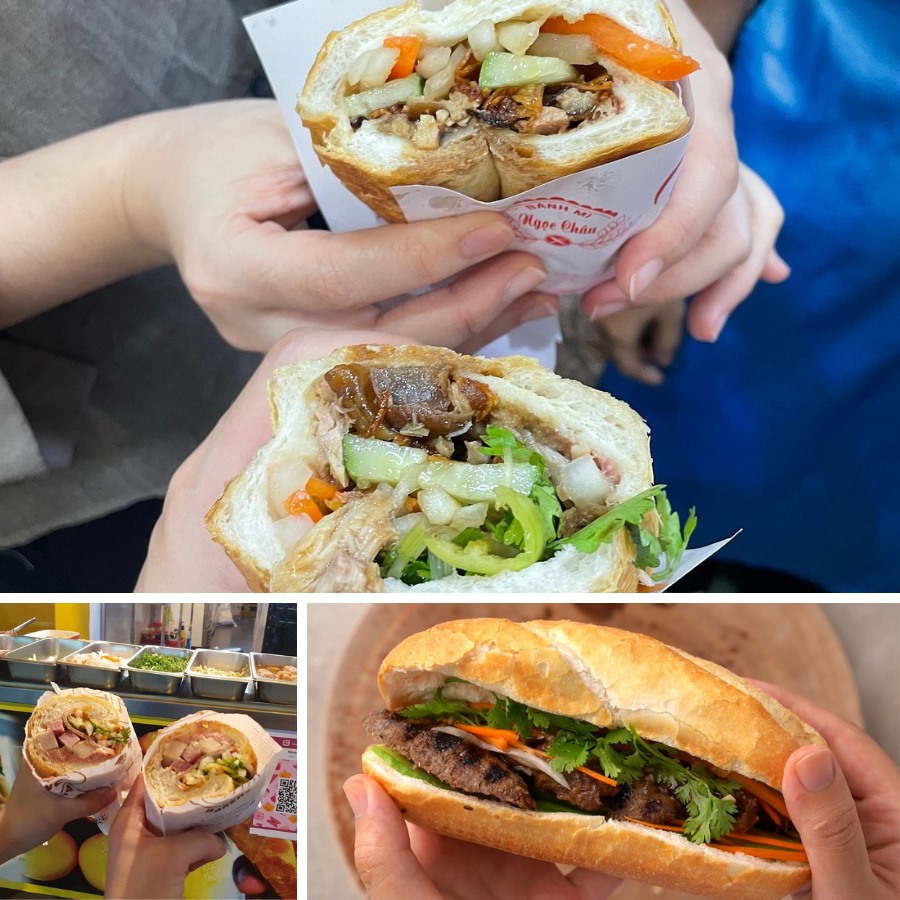
Where do you find the best banh mi in Saigon? The best banh mi in Saigon is a busy neighborhood cart with a griddle running and a line of people in work clothes, not the most-photographed famous name. A great everyday sandwich costs about 20,000-30,000 VND (~$0.75-1.15 USD); landmark shops like Banh Mi Huynh Hoa charge roughly 65,000-73,000 VND (~$2.50-2.80 USD). The one test that never lies: squeeze the bread. A fresh crust shatters; a stale one squashes.
We are women-led ao dai motorbike guides, and we eat banh mi on the way to work, not for the camera. So instead of another list of the five shops every blog names, this guide does two things at once: it teaches you how to judge any cart yourself, and it hands you a shortlist of eight real stalls our riders actually queue at, by district, with addresses, hours and prices. Figures were checked in August 2026 and may change, so treat them as a starting point.
The 8 carts our riders actually eat at
These are real, long-running stalls spread across the districts foreign travellers stay in, ranked by how often our riders send guests to them rather than by fame. Low-cost local carts and one famous name are both here on purpose, so you can compare value with your own eyes.
| Cart & district | Signature | Price | Hours (approx.) | Why our riders go |
|---|---|---|---|---|
| Banh Mi Bay Ho – 19 Huynh Khuong Ninh, Da Kao, District 1 | Xiu mai (pork meatball) | 15,000-25,000 VND (~$0.60-0.95) | ~05:30-11:00, 12:00-19:00 | An 80-year-old alley cart; the lowest-cost famous name in town and still the meatball bar everyone else is measured against |
| Banh Mi Hien – 71 Nguyen Dinh Chieu, Phu Nhuan | Xiu mai with extra pate | 20,000-25,000 VND (~$0.75-0.95) | Mornings | The neighborhood xiu mai locals rate over the tourist names; almost no foreigners |
| Banh Mi 232 – Hem 232 Ba Hat, District 10 | Full house cold-cut banh mi | 20,000-30,000 VND (~$0.75-1.15) | ~16:00-23:00 | A true no-name hem (alley) cart; this is the local price floor a full banh mi should cost |
| Banh Mi 37 – alley off Nguyen Trai, District 1 | Charcoal-grilled xiu mai | 25,000-30,000 VND (~$0.95-1.15) | A few afternoon hours only | No menu board, no seating, just a charcoal grill; the smokiest meatball in the centre if you time it right |
| Banh Mi Sau Minh – 170 Vo Van Tan, District 3 | Cold cuts | 40,000-50,000 VND (~$1.55-1.90) | Open 24 hours | The answer to a 2am craving; genuinely open around the clock |
| Banh Mi Nhu Lan – 500 Ham Nghi, District 1 | Widest range, incl. chay | 30,000-50,000 VND (~$1.15-1.90) | ~05:00-24:00 | Landmark shop with a huge menu and long hours; the safe “anytime, everyone finds something” pick |
| Banh Mi Hoa Ma – 53 Cao Thang, District 3 | Op la (eggs in a pan) | 50,000-70,000 VND (~$1.90-2.70) | ~06:00-11:00, mornings only | A 50-year-old breakfast institution; you assemble your own from a sizzling skillet |
| Banh Mi Huynh Hoa – 26 Le Thi Rieng, District 1 | Loaded cold cuts & pate | 65,000-73,000 VND (~$2.50-2.80) | ~06:00-22:00 | The famous one; worth doing once for the sheer overstuffed spectacle, but you pay for the name and the queue |
Which district to hunt in: District 1 has the famous names and the most convenient central carts (Huynh Hoa, Nhu Lan, and the Da Kao old-timer Bay Ho). District 3 is the old-school heartland (Hoa Ma for eggs, Sau Minh around the clock). For carts with almost no tourists, cross into Phu Nhuan or District 10 and follow the office and school queues at rush hour.
How to spot a great cart in five seconds
You can judge any banh mi cart before you order it: look for fast turnover, a griddle toasting bread to order, and a queue of people in work clothes rather than people holding cameras.
Turnover is everything. A cart that sells out twice a day is buying fresh bread twice a day, so the crust is still alive when it reaches you. Watch whether the vendor warms your baguette on the griddle before filling it: that ten-second toast is the difference between a crust that shatters and one that bends. Then look at the pate and the pickles, not the meat. Good do chua (pickled carrot and daikon) looks bright and is added by the pinch; a soggy grey heap means the sandwich will steam itself limp before you finish it. Our simplest rule for guests: follow the workwear queue, not the camera queue. Delivery drivers and market sellers will not wait 20 minutes or overpay, so wherever they cluster is usually the honest-value cart.
The two we point people to: For the loaded, famous version, Banh Mi Huynh Hoa on Le Thi Rieng is the heavyweight – pate, cold cuts and pork stacked high. For the old-school opposite, Banh Mi Bay Ho has been going about ninety years and even turned up on Netflix. Beyond the names, the tell for any cart is simple: a queue of local workers, a charcoal smell, and someone who splits the bread and toasts it before filling it.
Where banh mi came from (60 seconds)
Banh mi is a French colonial baguette rebuilt as a Vietnamese sandwich: the light wheat-and-rice-flour bread stayed, and cooks filled it with local pate, pickles, herbs, chili and cold cuts. The word “banh mi” was formally added to the Oxford English Dictionary in 2011, which is roughly when the world outside Vietnam started arguing about who makes the best one. Knowing this helps you order: the bread should taste airy and neutral, a vehicle for everything inside, never dense or sweet like a Western sandwich loaf.
The classic fillings, explained
The three fillings Saigon locals actually argue about are thit nguoi (mixed cold cuts), xiu mai (pork meatballs) and op la (fried eggs), and each suits a different moment of the day.
| Filling | What it is | Best eaten |
|---|---|---|
| Thit nguoi | Vietnamese cold cuts – ham, headcheese and pork roll – with pate | Any time; the standard all-rounder |
| Xiu mai | Soft pork meatballs simmered in a light tomato sauce, spooned in warm | Breakfast, or a saucy, filling lunch |
| Op la | Fried eggs, usually served in a small pan with the fillings on the side | Breakfast, eaten with a fork before you build it |
Grilled pork (thit nuong) and shredded chicken (ga) turn up everywhere too, but the three above are the ones a Saigonese will have strong opinions about.
What a banh mi should cost
A neighborhood banh mi in Saigon should cost about 20,000-30,000 VND (~$0.75-1.15 USD); pay much more and you are buying either a heavier load of cold cuts or a famous name. Prices are effectively fixed per stall, so you never bargain for a banh mi.
| Type | Typical price | Where you find it |
|---|---|---|
| Corner / hem cart | 20,000-30,000 VND (~$0.75-1.15 USD) | Residential streets, near markets and schools |
| Busy stall / small shopfront | 30,000-50,000 VND (~$1.15-1.90 USD) | Central areas, grilled-meat and around-the-clock versions |
| Landmark name (e.g. Huynh Hoa) | 65,000-73,000 VND (~$2.50-2.80 USD) | District 1, packed with cold cuts and pate |
If a vendor quotes far above these ranges, just walk to the next cart rather than negotiating. For where bargaining actually applies in Vietnam, our bargaining guide draws the line.
How to order banh mi in Vietnamese
You can order a banh mi with three words: point, say the filling, and add “mang di” for takeaway. Vendors are used to travellers, so a smile and the right noun get you a long way.
- Mot o banh mi thit (mot oh bang mee tit) – “one cold-cut banh mi”
- Banh mi xiu mai / op la / chay – meatball / fried egg / vegetarian
- Khong cay (khong kai) – “no chili”
- It pate (it pa-tay) – “less pate” (it can be rich)
- Mang di (mang dee) – “takeaway”; an o day – “eat here”
- Bao nhieu? (bao nyew) – “how much?”
Vegetarian banh mi (banh mi chay)
Vegetarian banh mi is easy to find in Saigon and usually costs 15,000-25,000 VND (~$0.60-0.95 USD) at pagoda-area stalls. Look for stalls marked “Banh Mi Chay,” which cluster near Buddhist pagodas, and for the reliable chay option on the menu at Banh Mi Nhu Lan (500 Ham Nghi) if you want a sure thing in the centre.
The chay build swaps meat for fried tofu, soy-based mock meats and a savoury mushroom pate, keeping the pickles, herbs and chili. Vegetarian carts multiply on the 1st and 15th of the lunar month, when many locals eat meat-free, so those are the best two days to hunt. If you keep a strict vegan diet, ask whether the mayo and pate contain egg or dairy, since recipes vary from stall to stall.
When the famous name is NOT worth it
Skip the landmark shops if you are short on time, hungry now, or want breakfast eggs – the queue, the hours and the value all point to the cart nearest wherever you woke up.
Huynh Hoa can mean a 15-20 minute line and a 65,000-73,000 VND price for a sandwich so overstuffed it is hard to eat one-handed, and it serves no op la, so it is the wrong stop for a quick morning egg fix. Hoa Ma closes before noon and is a real detour if you are not already in District 3. For a normal hungry morning, a fresh corner cart gives you hotter bread, no wait, and enough change left for a Saigon coffee to go with it. Save the famous names for a day you are curious, not a day you are rushing. First-timers can slot this into the wider plan with our first time in Saigon guide.
The one thing worth outsourcing is the local sourcing itself. On our Saigon food tour ($59 USD per person) we ride to the exact off-the-clock carts above, so you taste the neighborhood version and learn the bread test by doing it, not guessing. Nervous about eating from a cart at all? Our street food safety guide covers how to pick a stall that will not make you sick.
FAQ: Banh Mi in Saigon
What is the most famous banh mi in Saigon?
Banh Mi Huynh Hoa (26 Le Thi Rieng, District 1) is the most famous banh mi shop in Saigon, known for a heavy load of cold cuts and pate at roughly 65,000-73,000 VND (~$2.50-2.80 USD). Banh Mi Hoa Ma in District 3 is the best-known name for the op la (fried egg) style. Figures were checked in August 2026 and may change.
How much does a banh mi cost in Ho Chi Minh City?
A banh mi from a Saigon corner or alley cart costs about 20,000-30,000 VND (~$0.75-1.15 USD). Busy shopfronts with grilled meat or 24-hour service run 30,000-50,000 VND, and famous names like Huynh Hoa charge roughly 65,000-73,000 VND. Prices are fixed per stall, so you do not bargain.
Where do locals eat banh mi in Saigon?
Locals in Saigon mostly eat at long-running neighborhood carts rather than the Instagram-famous shops. Examples include Banh Mi Bay Ho (19 Huynh Khuong Ninh, Da Kao) and Banh Mi Hien (71 Nguyen Dinh Chieu, Phu Nhuan) for xiu mai, and hem carts like Banh Mi 232 (Ba Hat, District 10). The reliable sign is a queue of people in work clothes.
Is street-cart banh mi safe to eat?
Street-cart banh mi in Saigon is generally safe when you pick a busy stall with high turnover, because fresh bread and quick-selling fillings sit out for less time. Choose a cart that toasts bread to order and has a steady line of locals, and go easy on raw chili if your stomach is sensitive.
What time does Banh Mi Hoa Ma open and close?
Banh Mi Hoa Ma (53 Cao Thang, District 3) is open mornings only, roughly 06:00 to 11:00, and often sells out before it closes. It is the op la specialist, so arrive before 10:00 for the full skillet experience. Hours were checked in August 2026 and may change.
Is Banh Mi Huynh Hoa worth the price and the queue?
Banh Mi Huynh Hoa is worth one visit for the spectacle of an overstuffed cold-cut sandwich, but at 65,000-73,000 VND (~$2.50-2.80 USD) and a 15-20 minute line it is poor value for an everyday meal. If you want a quick, fresh, low-cost banh mi, a busy neighborhood cart will beat it for a third of the price.
Is there vegetarian banh mi in Saigon?
Yes, vegetarian banh mi (banh mi chay) is widely available in Saigon, using tofu, soy mock meats and mushroom pate. Pagoda-area stalls marked “Banh Mi Chay” charge about 15,000-25,000 VND (~$0.60-0.95 USD), Banh Mi Nhu Lan on Ham Nghi carries a chay option, and more stalls appear on the 1st and 15th of the lunar month.
How do you order banh mi in Vietnamese?
To order, say “mot o banh mi thit” for one cold-cut banh mi, or swap in “xiu mai” (meatball), “op la” (egg) or “chay” (vegetarian). Add “khong cay” for no chili and “mang di” for takeaway. Most vendors are used to travellers, so pointing plus the filling name works fine.