
Short answer: The single fact that decides your Vietnam layover is whether you are on one through-ticket with a through-checked bag, or on separate tickets. On one ticket, connecting is usually straightforward. On separate tickets, you almost always must clear immigration, collect your checked bag, exit, switch terminals, and check in again from scratch, so you need a generous buffer. Nothing in this post replaces your own ticket and airline rules, but it tells you what to check and where the real risk is.
If you have a connection at Tan Son Nhat (SGN) in Ho Chi Minh City or Noi Bai (HAN) in Hanoi, your worry is simple: is the gap between flights long enough, and what do you actually have to do in between? This guide answers that in order, so you know before you land whether you can relax or need to move quickly.
The one question that decides everything
Before you think about minutes, answer this: is your whole journey on a single ticket, or on two or more separate tickets?
- One through-ticket: the airline booked both flights together and through-checked your bag to the final destination. You collect nothing in the middle, and your bag is handled for you. This is the easy case.
- Separate tickets: you booked the international leg and the domestic leg on different bookings, often with a budget carrier for one of them. Here the two airlines do not talk to each other. You are your own transfer service.
How to tell which one you have: look at your booking. If you received a single itinerary with both flights and one booking reference, and your bag tag at the origin airport shows your final Vietnamese city (not just the arrival airport), you are through-checked. If you have two separate confirmations, or the bag tag stops at your first Vietnam airport, treat it as a self-transfer.
Why terminals matter: big Vietnamese airports keep domestic and international flights in separate terminals. Tan Son Nhat has a domestic terminal and a nearby but separate international terminal. Noi Bai splits into T1 (domestic) and T2 (international). International-to-domestic almost always means moving from one terminal to another.
International-to-domestic on separate tickets, step by step
This is the case that catches people out. If you arrive on an international flight and your next flight is domestic on a separate ticket, plan for all of these steps:
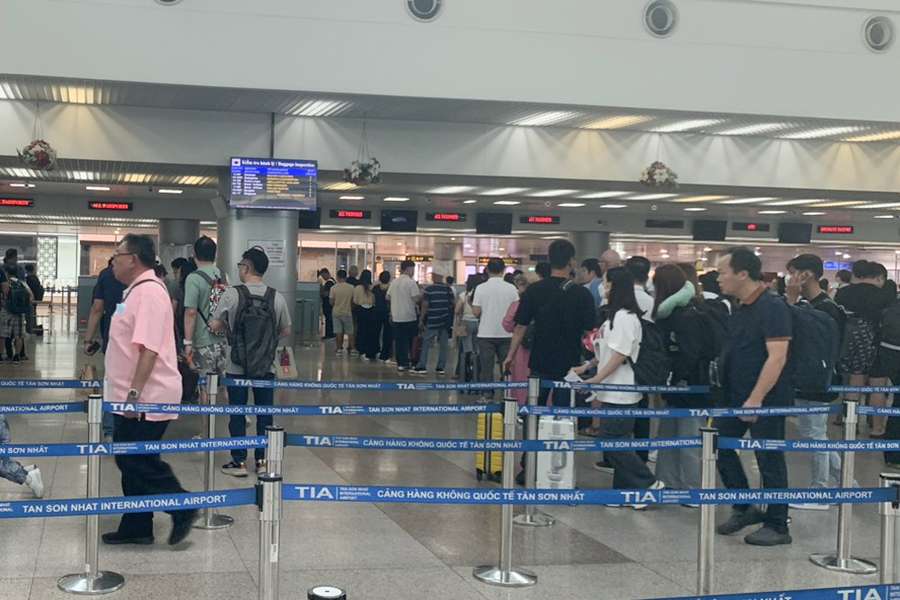
- Clear immigration. As a foreign tourist you use the manual immigration counters. You cannot use the automatic e-gates on entry, so allow for a queue, which can be long at peak arrival times.
- Collect your checked bag. On a self-transfer, no one moves your bag for you. Go to baggage claim and pick it up.
- Clear customs and exit. You leave the international arrivals area into the public part of the airport.
- Move to the domestic terminal. At SGN and HAN this is a separate building. It is close, but you still need to walk or take a short shuttle, and that takes time, especially with bags.
- Check in for the domestic flight. You start a fresh check-in: drop your bag, get a boarding pass, and pass through domestic security. You are effectively a new departing passenger.
Because the first airline is not responsible for your onward flight in this setup, a missed domestic connection is your cost, not theirs. That is the core reason self-transfers need extra time.
When you can skip most of this
You do not need the full drill in a few situations. If you are on one through-ticket with a through-checked bag, you usually stay airside and follow transfer or connection signs without collecting luggage. If both your flights are domestic, there is no immigration and no terminal switch of the international kind. And if you have no checked bag at all, you remove one of the slowest steps. The heavy version above applies mainly to international-to-domestic self-transfers with checked luggage.
How to estimate a safe buffer
There is no single safe number, and anyone who gives you one without knowing your trip is guessing. Instead, judge your buffer against these factors:
- One ticket or separate tickets. Separate tickets need clearly more time because of the full immigration, bag, and re-check sequence.
- Checked bag or carry-on only. A checked bag adds waiting at the belt plus a new bag drop.
- Time of day. Immigration queues swell when several international flights land together, often mornings and evenings.
- Terminal change. International-to-domestic almost always means a terminal move; same-terminal connections are faster.
- Your own pace. Traveling with children, elderly parents, or a lot of luggage slows every step.
- Delay risk. If your inbound flight runs late, your buffer shrinks in real time. Build in room for a delayed arrival.
The practical rule: for a self-transfer, be generous rather than tight, and always confirm the minimum connection guidance for your specific airline and airports. When you have a real choice, a longer layover on a self-transfer is far less stressful than a short one.
What to do with a long layover
A long gap is not wasted time. You have two sensible options:
- Leave the airport. If you hold a valid e-visa or other entry permission, you can clear immigration and go into the city, then return for your next flight. Give yourself plenty of time to come back and repeat security and any check-in.
- Stay airside and rest. If you would rather not leave, lounges are available for travelers waiting between flights. This suits short-to-medium waits or overnight connections when you just want to sit somewhere quiet.
If you plan to leave the airport, check your visa or entry status before you travel, not on arrival, so there is no surprise at the counter.
When an escort or assist service is worth it, and when it is not
An airport fast track service means someone meets you and guides you through the connection: immigration, baggage, the terminal change, and re-check-in. It is most useful when:
- You are on a tight self-transfer and every minute counts.
- It is your first time in Vietnam and you would rather not decode signage under time pressure.
- You are traveling with family, small children, or elderly relatives.
- You are worried specifically about the immigration queue eating your buffer.
You probably do not need it when your journey is on one through-ticket with a comfortable layover, when both flights are domestic, or when you are an experienced connector traveling light with plenty of time. There is no shame in either choice. Use help where it removes a real risk, and skip it where the connection is genuinely simple. If you want, we can quote an assist service for your specific flights; pricing depends on your airports, timing, and group size.
A short pre-trip checklist
- Confirm whether you are on one ticket or separate tickets.
- Check whether your bag is through-checked to your final Vietnamese city.
- Note whether you change terminals, and roughly how.
- Confirm your airline’s minimum connection guidance and leave a buffer on top.
- Check your visa or entry status if you might leave the airport.
- Have your onward booking details ready for a fresh check-in.
FAQ: Vietnam airport layovers and connections
Do I have to clear immigration during a layover in Vietnam?
If your onward flight is domestic, or you leave the airport, yes. International arrivals clear immigration at manual counters, and foreign tourists cannot use the automatic e-gates on entry. On a single through-ticket where you stay airside for another international flight, you may not need to, but always follow the signage and your airline’s instructions.
How do I know if my bag is checked through to my final city?
Check your booking and your bag tag at the origin airport. One booking reference for both flights and a bag tag showing your final Vietnamese city usually means through-checked. Two separate confirmations, or a tag that stops at your first Vietnam airport, means you collect and re-check the bag yourself.
What is the minimum safe layover time?
There is no fixed number that fits every trip. It depends on one ticket versus separate tickets, whether you have a checked bag, the time of day, and whether you change terminals. Confirm your airline’s minimum connection guidance and add a buffer on top, especially for a self-transfer.
Are the domestic and international terminals in the same building?
At Tan Son Nhat and Noi Bai they are separate. Tan Son Nhat has a domestic terminal and a separate international terminal nearby; Noi Bai uses T1 for domestic and T2 for international. Moving international-to-domestic usually means changing terminals, so allow time for the transfer.
Can I leave the airport during a long layover?
Yes, if you hold a valid e-visa or other entry permission. Clear immigration, go into the city, and return with plenty of time to repeat security and check-in. Confirm your entry status before you travel rather than relying on sorting it out at the counter.
My tickets are separate. Is the first airline responsible if I miss the second flight?
No. On separate tickets, the airlines are not linked, so a missed onward flight is your responsibility. This is exactly why self-transfers need extra time and why some travelers use an assist service or buy a flexible onward fare.
What happens if my incoming flight is delayed?
Your buffer shrinks by however long the delay lasts. On a through-ticket the airline generally helps rebook a missed connection; on separate tickets you would need to sort out the next flight yourself. Build in room for delays when you choose your layover length.
Do I need an airport escort service to make my connection?
Not always. It helps most on tight self-transfers, first visits, or when traveling with children or elderly family. You can usually skip it on a single through-ticket with a comfortable layover or a simple domestic-to-domestic connection. Ask us for a quote based on your flights if you want a set of hands through the process.
Need help making a tight connection? Message us on WhatsApp – +84 901 006 844