
Short version of what to wear in Vietnam: light, breathable clothes that can cover shoulders and knees. Saigon sits at 25–35°C all year, Hanoi drops to around 17°C in January, and Sapa can touch freezing. Bring closed shoes, one long layer and a poncho — and if you are riding pillion with us, leave the flip-flops in the hotel.
What Do You Actually Need to Pack?
Vietnam has no national dress rules for visitors, so what to wear in Vietnam comes down to three things: heat, rain, and covering up at temples. Everything else is your own taste.
The country runs 1,650 km from north to south, and that distance is the whole packing problem. A traveller doing Saigon in March needs almost nothing warm. The same traveller adding Sapa in January needs a real jacket. Below is what our riders see work, after welcoming 100,000+ guests onto the back of a motorbike. Put simply, what to wear in Vietnam is whatever suits the latitude you are standing at.
What to Wear in Vietnam by Region and Season
Vietnam has three climates, not one: the south is hot year-round, the centre has a hard autumn rainy season, and the north has a genuine cool winter.
| Region | What the weather does | What to pack |
|---|---|---|
| South — Saigon, Mekong, Phu Quoc | 25–35°C all year; rain May–October, usually a short afternoon downpour | Cotton and linen only, poncho, sun cover |
| Centre — Da Nang, Hoi An, Hue | Hot most of the year; rainy season September–December, peaking October–November | Quick-dry everything, a rain layer, shoes you do not mind soaking |
| North — Hanoi, Ha Long | Hot humid summers; January averages about 17°C and feels colder because it is damp | Layers, one warm jacket if visiting December–February |
| Mountains — Sapa, Ha Giang | December–January days around 5–10°C, nights can reach 0°C | Proper jacket, thermal layer, grippy shoes |
So what to wear in Vietnam in January depends entirely on how far north you go. Two dates worth knowing: the dry, comfortable window in Saigon runs roughly December to April, and Da Nang’s wettest stretch is October and November, when the city can take over 600 mm of rain in a single month. If you are still choosing dates, our guide to the best time to visit Vietnam goes month by month, and there is a separate one for the best time to visit Da Nang.
What to Wear in Vietnam’s Temples and Pagodas
The rule at every pagoda, temple and communal house in Vietnam is the same: shoulders covered, knees covered, shoes off before the main hall. It applies equally to men and women.
That is the one rule about what to wear in Vietnam that is not negotiable. Nothing more complicated than that. Loose trousers, a maxi skirt or a long dress all pass. A T-shirt with sleeves is fine — you do not need long sleeves. Tank tops, crop tops and short shorts do not pass, and at smaller neighbourhood pagodas nobody will lend you a cover-up.
The habit that solves it: keep a light scarf folded in your day bag. It weighs nothing, turns any outfit into temple-appropriate clothing in about four seconds, and doubles as a blanket on over-air-conditioned buses. In Vietnam you tend to walk past a pagoda by accident rather than plan for one, so carrying the scarf beats going back to change. It is the single best trick for what to wear in Vietnam when you are out all day. More on the etiquette around it in our notes on Vietnamese culture.
What Should You Wear on a Motorbike Tour?
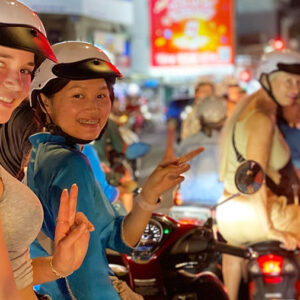
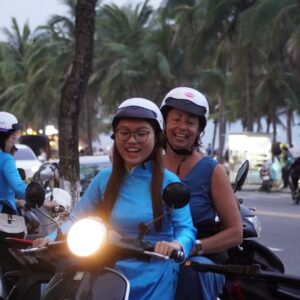
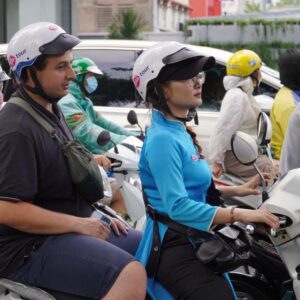
On a motorbike tour you want closed shoes, something you can sit astride, and hair you can tie back — the helmet is provided and is not optional. This is the part of what to wear in Vietnam that is about safety rather than comfort.
This is the part travel blogs get wrong, because most of them have never ridden. Here is what our áo dài riders tell guests about what to wear in Vietnam on a bike, in the order it actually matters:
- Closed shoes. Trainers, or sandals with a back strap. Flip-flops slide off the footpegs, and worse on wet pavement.
- Trousers, a long skirt with a slip, or shorts you can sit astride in. A tight knee-length skirt is the one garment that genuinely does not work on a bike.
- Something to tie long hair back. Under a helmet, in Vietnamese humidity, you will want it within the first kilometre.
- No hat. You cannot wear one under a helmet. Bring sunglasses and sunscreen instead.
- A crossbody bag or small backpack. Storage on the bike is limited, so bring what you can wear rather than what you have to hold.
- Not your white shirt on a food tour. Turmeric, chilli oil and fish sauce find fabric. Wear what you would take to a barbecue.
<!– QUOTE GUIDE — chờ Natalie xác nhận câu thật của Vy rồi bỏ dấu comment này:
–>
If riding pillion is new to you, the honest answer to the safety question is in our guide to whether motorbike tours in Saigon are safe — including when we tell people not to book.
What Fabrics Survive the Heat and the Rain?
Linen, cotton and bamboo viscose are the fabrics that work in Vietnam; polyester traps sweat and heavy denim never dries.
When guests ask what to wear in Vietnam in rainy season, we answer with fabric rather than garments. Humidity, not temperature, is what wears people down here. A cotton shirt soaked at noon dries by mid-afternoon; jeans soaked in a Saigon downpour are still damp at dinner. If you are travelling in rainy season, one quick-dry set is worth more than three cotton ones.
On rain gear: an umbrella is fine on foot and useless on a bike. Locals use full-length plastic ponchos that cover rider and bike together, and you can buy one at any market for roughly 20,000–50,000 VND (~$1–2). A conical nón lá costs around 30,000–80,000 VND (~$1–3) and works better as a sun hat than a souvenir. Prices are in Vietnamese đồng (VND); USD figures are approximate (≈26,100 VND to $1) and may change.
What Do People Wear in Vietnamese Cities?
Vietnamese cities are casual but neat — locals dress tidily even for errands, and you will rarely see a Vietnamese adult in a crop top or shirtless outside a pool.
What to wear in Vietnam’s cities is really a tidier version of what you already wear at home. Tourists get leeway, and nobody will stop you wearing shorts in District 1. But dressing a notch closer to local norms changes how you are treated in markets and family-run restaurants, and it costs you nothing. For dinner, a clean shirt and trousers is the ceiling; Vietnam is not a jacket-and-tie country, and even the rooftop bars in Saigon stop at smart casual. First-timers will find the rest of the practical groundwork in our guide to your first time in Saigon.
Beach towns follow one rule: swimwear on the sand, covered up the moment you leave it. Walking through Da Nang or Nha Trang in a bikini reads as rude rather than relaxed.
What Should You Leave at Home?
Four things travellers regret packing for Vietnam: heavy jeans, formal wear, white shoes, and a third and fourth pair of shoes.
The short answer to what to wear in Vietnam is two pairs of shoes and light layers you can wash in a sink. Jeans take a full day to dry and are miserable in humidity. Formal wear stays in the case. White trainers survive about two days of dust and one rainy-season pavement. And two pairs of shoes — one closed, one sandal — is all any itinerary here needs. For the full list, including the non-clothing items, see our honest Vietnam packing list.
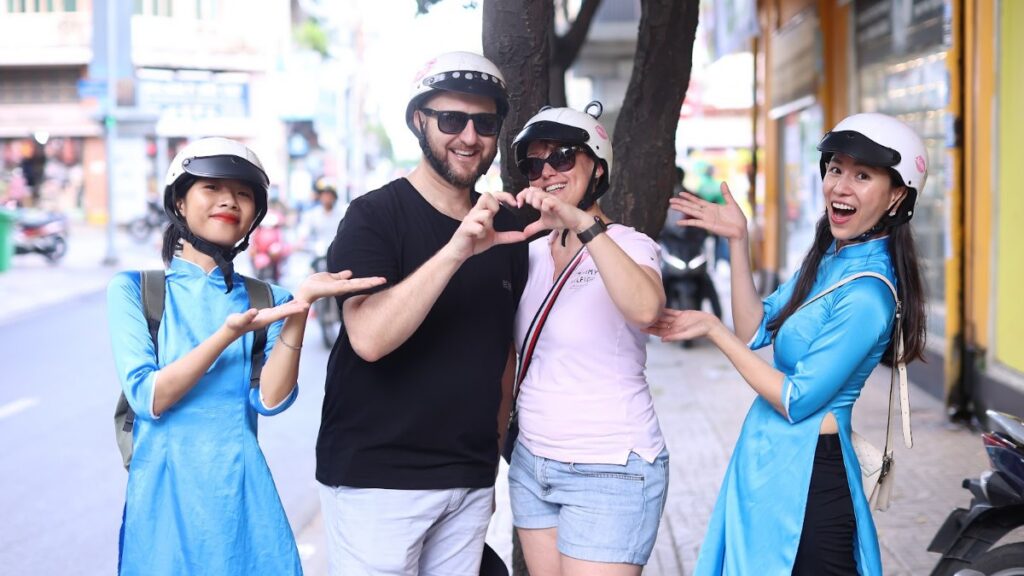
The upside of under-packing: Vietnam is an easy place to buy clothes. Markets in Saigon and Hanoi sell T-shirts and light trousers at market prices, and Hoi An will make something to measure in two days if you allow time for a fitting. The áo dài — the long tunic worn over trousers that our riders wear on tour — is the tailoring most guests come home with.
FAQ: Dressing for Vietnam
Can you wear shorts in Vietnam?
Yes — shorts are part of what to wear in Vietnam in cities, markets, beach towns and casual restaurants. Not at temples and pagodas, where knees must be covered, and it is better to cover up in rural villages.
Do women need to cover their hair in Vietnam?
No. Buddhism does not require head coverings. Hats are fine outdoors but should come off inside a temple’s main hall.
What should you wear to a pagoda in Vietnam?
Covered shoulders and knees, nothing sheer or tight, and shoes off before the sanctuary. Loose trousers or a long skirt with any sleeved top is the simplest combination.
What should you wear in Vietnam in summer?
In summer, what to wear in Vietnam is the lightest cotton or linen you own, plus one long layer for temples and over-cooled restaurants. Add a poncho between May and October in the south.
What shoes are best for Vietnam?
One pair of broken-in closed shoes and one pair of sandals with a back strap. Skip anything white and skip new shoes — you will walk further than you plan to.
What do you wear on a Vietnam motorbike tour?
What to wear in Vietnam on a motorbike tour: closed shoes, trousers or something you can sit astride in, hair tied back, and a crossbody bag. Helmets and ponchos are provided on every KissTour ride.
Is it rude for foreigners to wear an áo dài?
No — it is generally taken as a compliment, and it is common at festivals and photo shoots. It reads oddly for everyday market shopping, that is all.
Still not sure what to wear in Vietnam on day one? Book the Saigon City Tour ($45 USD, half-day) and turn up in trainers — helmet, poncho and áo dài rider are ours to provide. 100% women drivers, rated 5.0 from 2,539 TripAdvisor reviews (July 2026), and you book now, pay cash after the tour.