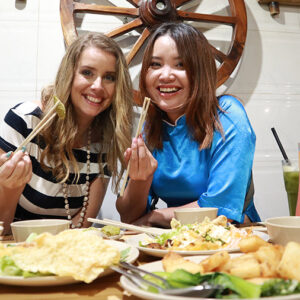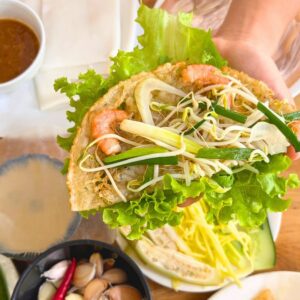

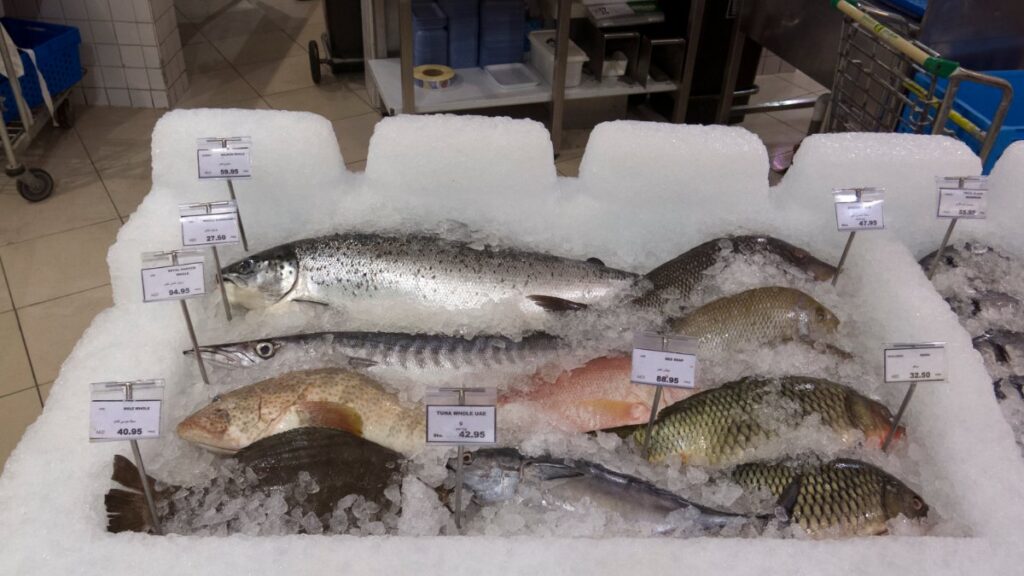
Where do locals eat seafood in Da Nang? They skip the bright beachfront barns on Vo Nguyen Giap and eat one street back, or out in the Man Thai and Tho Quang fishing villages on the Son Tra side, on plastic stools by the water. Order crab (ghe), sea snails (oc) and prawns (tom) priced live by weight, and before you point at a tank ask one question: “mot ki hay mot lang?” – per kilo, or per 100 grams? A relaxed local dinner runs about 200,000-350,000 VND (~$8-13 USD) a head; a Michelin-listed fishing-village spot like Nam Danh serves dishes from 60,000 VND (~$2.30 USD).
I run women-led ao dai motorbike tours in Da Nang, and the same worry comes up on the seat behind me almost every night: “Will the seafood place cheat me?” Here is the honest version, from someone who eats in these villages on her days off. Da Nang seafood is some of the freshest and best-value in Vietnam – if you understand the one pricing rule below. Get it wrong and the same plate of crab can cost you double. This guide covers how locals order, where they sit, what they drink, and when a beachfront table is not worth it.
All prices below were checked in August 2026 and shift with the season, the daily catch and the venue. Treat them as honest ranges, not fixed quotes.
The one question that decides your bill: “mot ki hay mot lang?”
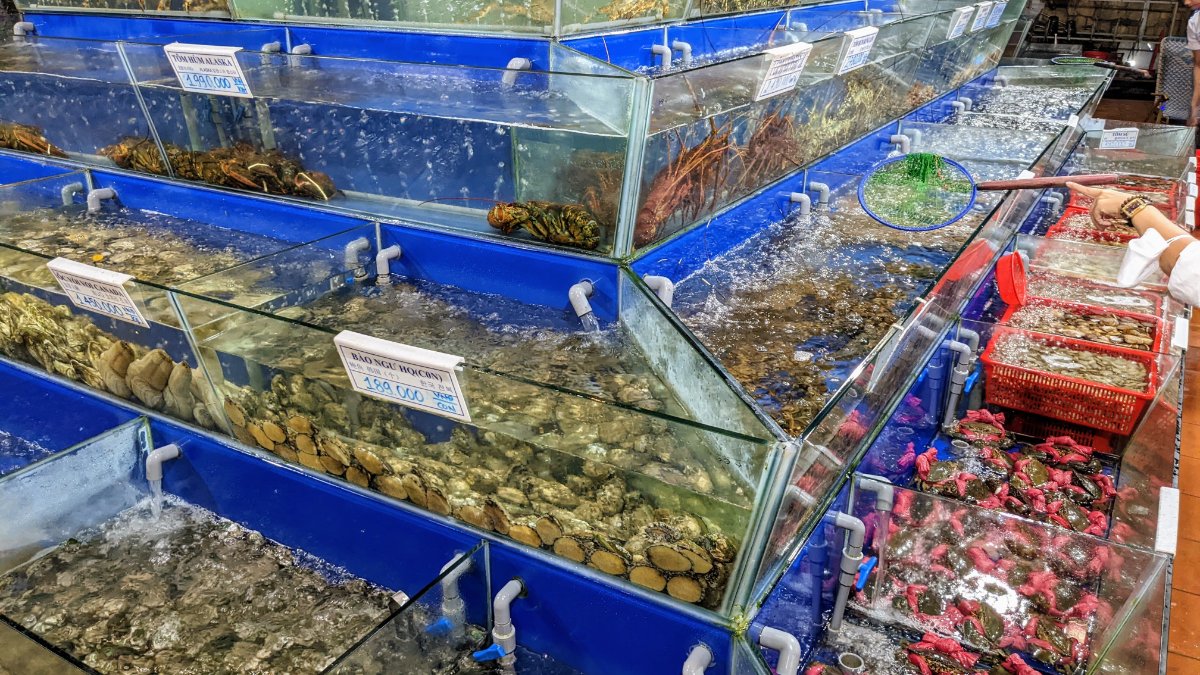
Da Nang seafood is priced by the live weight of the animal – almost always per kilogram (mot ki) or per 100 grams (mot lang) – weighed in front of you before cooking, with a small cooking fee added per dish. The gap between those two units is a factor of ten, and that gap is where nearly every “overcharge” story actually comes from.
The sequence is the same everywhere. You point at a tank, staff scoop the animal into a dry basket and weigh it out of the water while you watch, you choose how it is cooked, and the kitchen adds a cooking fee of roughly 30,000-100,000 VND (~$1.15-3.85 USD) per dish. That fee is legitimate and standard – you are paying for the cooking, not being scammed. What trips travellers up is the unit: a prawn price that looks like a steal at “180” is often 180,000 VND per 100 grams, not per kilo – ten times what you assumed. So ask, out loud, “mot ki hay mot lang?” before anything is weighed, and agree the weight before it goes to the kitchen.
Be honest with yourself about the real risk too: at tourist-facing barns, foreigners are quietly quoted 30-100% more than the Vietnamese table next to them, and “market price” (thoi gia) fish can be whatever the staff decide when the bill lands. It is not universal, and it is not most places – but it is real, and it is exactly why locals eat where locals are watching. Typical live-weight prices to sanity-check against: swimming crabs and whelks run about 120,000-450,000 VND/kg (~$4.60-17.30 USD), mantis shrimp (tom tich) 350,000-600,000 VND/kg (~$13-23 USD), and premium reef fish can climb to 3,950,000 VND/kg (~$152 USD), so always ask before you point.
The three-tier price map: where to sit
Da Nang eats seafood at three price tiers, and the address tells you which one you are in before you sit down – ride 300 metres and the same crab changes price.
| Tier | Where | Vibe | Cost/head | Overcharge risk | Best for |
|---|---|---|---|---|---|
| Beachfront barns | Vo Nguyen Giap seafront | Big, bright, tour-bus crowd, sea view | Highest | Highest – two-tier pricing common | A sunset view you will pay for |
| One street back | Ho Nghinh & Pham Van Dong | Calmer, mixed local-visitor crowd | Middle (~200,000-350,000 VND / $8-13) | Moderate | Couples, a quieter dinner |
| Fishing villages | Man Thai & Tho Quang (Son Tra) | Plastic stools, local families, bay at sunset | Lowest, best value | Low – locals watch the scales | Eating where locals actually eat |
For the real thing, ride across the Han River to Son Tra. Nam Danh in Tho Quang is in the Michelin Guide Vietnam and serves most dishes at 60,000-100,000 VND (~$2.30-3.85 USD) on plastic stools facing the water – a full spread of crab, snails, fried rice and beer for two lands under 500,000 VND. Be Man at Lot 8 Vo Nguyen Giap (the Man Thai end) is also Michelin-recommended and runs about 200,000-350,000 VND (~$8-13 USD) a head. For a bigger, tidier sit-down closer to the beach, My Hanh on Vo Nguyen Giap is Michelin Selected, and Brilliant Seafood on Ho Nghinh is a large multi-storey option good for groups.

What to order (and how to say the cooking method)
Order the three things Da Nang families order – ghe (crab), oc (sea snails) and tom (prawns) – then one distinctive local plate and whatever fish is alive in the tank that day.
The staples: ghe (blue swimmer crab), best steamed with a lime-salt-pepper dip or as cua rang me (tamarind-glazed crab); oc, dozens of snail types eaten with a toothpick, chilli and lemongrass; and tom, from small local prawns to mantis shrimp, which many visitors like more than lobster. Then reach past the obvious for the dishes that mark you as someone who did their homework:
- Goi Ca Nam O – marinated raw-fish salad from Nam O fishing village on the city’s north edge, Da Nang’s most distinctive seafood dish and hard to find outside the area.
- Oc Hut – small snails simmered in a lemongrass-chilli-coconut broth that you literally suck (“hut”) straight from the shell.
- So Diep Nuong Mo Hanh – scallops grilled with scallion oil and crushed peanuts, ordered by the piece.
Half the confidence is naming the cooking method. Point at the tank, then say the word:
| Vietnamese | Method | Good on |
|---|---|---|
| hap | steamed | crab, clams, whole fish |
| nuong | grilled over charcoal | scallops, prawns, oysters |
| rang me | tamarind stir-fry | crab, mantis shrimp |
| nuong mo hanh | grilled with scallion oil | scallops, razor clams |
| chien mam | fish-sauce fried | prawns, small crab |
A good sharing order for two: two crabs steamed (hap), one plate of oc hut, one plate of grilled scallops, and a whole fish. That is variety over one big-ticket item – and it keeps you off the 3,950,000-VND/kg reef fish unless you truly want it.
What locals drink with it: not wine. The village table drinks Bia Larue (the green-bottle local beer, poured over ice), fresh nuoc mia (sugarcane juice) for the non-drinkers, and coconut water straight from the fruit. All three are low-cost, cut through the salt and chilli, and are what you will see on every neighbouring table. Skip the imported beer markup.
Fish market or restaurant?
A restaurant is simpler and safer for a first-timer; the fish market is lower-cost and fresher but needs an early alarm, some bargaining and a little Vietnamese.
| Tho Quang / Man Thai market | Fishing-village restaurant | |
|---|---|---|
| Price | 20-30% below retail | Live-weight price + cooking fee |
| Freshness | Straight off the boats | Live tanks, still excellent |
| Effort | Bargain, then find a cook stall | Sit, point, eat |
| Best time | Boats dock ~4-6 AM; retail from dawn | Lunch and dinner |
| Language | Vietnamese helps a lot | Menus often have photos |
Tho Quang Fishing Port on the Son Tra side is the largest in Central Vietnam. The boats return roughly 4-6 AM, and if you are there at dawn you can buy directly from the fishermen at the lowest prices in the city, then carry your haul to a nearby stall in Man Thai that cooks it for a small fee. It is a genuine experience – but it is a 5 AM one. Unless you love an early market and a haggle in Vietnamese, most visitors eat better, with less stress, at a village restaurant come evening.
Is a seafood buffet worth it?
An all-you-can-eat buffet is worth it only if you value predictability and volume over pointing at your own crab – the price is fixed, so there is zero weighing anxiety, but you trade the fishing-village atmosphere for a bright dining hall.
Roughly what 2026 buffets cost per person:
- Budget, ~259,000 VND (~$10 USD): oysters, shrimp, some meat and ice cream, about two hours.
- Mid-range, ~349,000 VND (~$13 USD): adds sashimi and crab.
- Premium – All Seasons, up to ~1,550,000 VND (~$60 USD): Da Nang’s unlimited-lobster buffet, 60-plus dishes.
Choose the buffet if you are a big group, feeding hungry teenagers, or you simply want a known number on the bill and lots of variety. Choose a fishing-village restaurant if you want the freshest single crab, the local atmosphere and a lower spend for two – which, honestly, is most of our travellers. A buffet is a smart value play for four or more; for a couple, a la carte in Man Thai usually beats it on both taste and price.
Mistakes to avoid
The travellers who overpay almost always make the same small errors. Avoid these and you will eat like a regular:
- Not asking the unit. Say “mot ki hay mot lang?” before anything is weighed, every single time.
- Not watching the scale. The animal should be weighed in a dry basket, out of the water, in front of you. Agree the weight out loud.
- Skipping the photo. Snap the tank price tag and your chosen seafood on the scale; check the itemised bill against it before paying. A phone kitchen-scale app can sanity-check the weight if something feels off.
- Over-ordering. Portions are bigger than they look – order about 70% of what you think you want and add more if you are still hungry.
- Arriving too late. Get there by 18:00. The best dishes sell out and queues build by 20:00 at popular spots.
- Assuming you can tap a card. Terminals are unreliable at village places – bring cash, which also makes checking and splitting easier.
- Accepting “thoi gia” blind. If a fish is listed at market price, get the number for today before it is cooked.
When it is NOT worth it: who should skip the beachfront barns
If your priority is value, freshness and eating where locals eat, skip the big Vo Nguyen Giap beachfront barns entirely and go one street back or out to Son Tra instead.
The barns are not a scam, but you pay a premium for the location, the crowd skews to tour buses, and they carry the highest two-tier-pricing risk in the city. They are the wrong call for solo travellers on a budget, for anyone who dislikes a loud room, and for anyone chasing the best crab-per-dong. They earn their keep in exactly one case: you specifically want a sea-view sunset table and you do not mind paying for the view. If that is not you, ride five more minutes and eat better for less.
Let a local handle the tank talk
If decoding tank prices in Vietnamese on your first night sounds like work, this is exactly the meal a local guide makes effortless.
On our Da Nang food tour ($49 USD per person), a KissTour rider takes you to the stalls she eats at, orders the crab and snails at the price locals pay, and handles the whole “mot ki hay mot lang” conversation so you just eat – five or six things across one relaxed evening instead of gambling on a single restaurant. Prefer to explore after dark on two wheels? The Da Nang by night tour ($35 USD) pairs the harbour lights with street food. For more planning, see our wider Da Nang food guide and the Da Nang street food night market guide, and if you are torn between cities for eating, our Da Nang or Hoi An for food guide settles it.
Where locals actually eat: For the real dockside experience, Ba Ro in Tho Quang sits steps from the fishing port; for something closer to the beach, Be Man on Man Thai is the busy, long-trusted local pick. Wherever you go, ask them to weigh your seafood in front of you and confirm the price per kilo before it is cooked – a stall that does this without fuss is one you can trust. We order it grilled with salt and chili, with a plate of garlic morning glory on the side.
FAQ: Eating Seafood in Da Nang Like a Local
How much does a seafood dinner cost per person in Da Nang?
A relaxed local seafood dinner in Da Nang runs about 200,000-350,000 VND (~$8-13 USD) per person at a fishing-village or mid-range spot, more at the beachfront barns and more again if you order lobster. Ordering crab, snails and prawns to share keeps you in that range; a Michelin-listed village spot like Nam Danh can be less, from 60,000 VND (~$2.30 USD) a dish.
Is seafood in Da Nang priced per kilo or per dish?
Most seafood in Da Nang is priced by the live weight of the animal, usually per kilogram (mot ki) but sometimes per 100 grams (mot lang), weighed in front of you, plus a cooking fee of about 30,000-100,000 VND (~$1.15-3.85 USD) per dish. Always ask which unit applies before ordering, because the two differ by a factor of ten.
How do I avoid being overcharged for seafood in Da Nang?
Ask “mot ki hay mot lang?” (per kilo or per 100 grams) before anything is weighed, watch the seafood weighed dry in a basket in front of you, photograph the tank price tag and your pick on the scale, and check the itemised bill against that photo. A phone kitchen-scale app can verify the weight, and honest places will happily weigh in the open – walk out if one refuses.
Is the Da Nang seafood weighing scam real?
Genuine weighing fraud is rare, but foreigner-facing barns do quietly quote 30-100% more than locals pay, and confusion between per-kilo and per-100-gram pricing causes most “scam” stories. Watch the scale, agree the unit and weight out loud, and eat where locals eat, and the risk drops to near zero.
Where do locals eat seafood in Da Nang?
Locals eat seafood in the Man Thai and Tho Quang fishing villages on Son Tra, and on the calmer Ho Nghinh and Pham Van Dong blocks one street back from the beach, rather than at the bright Vo Nguyen Giap barns aimed at tour groups. Nam Danh in Tho Quang is a Michelin-listed local favourite.
What seafood should I order in Da Nang?
Order ghe (crab), oc (sea snails) and tom (prawns), plus mantis shrimp (tom tich) and whatever fish is live in the tank. For genuine local dishes, try Goi Ca Nam O (marinated raw-fish salad), Oc Hut (snails in lemongrass-chilli-coconut broth) and So Diep Nuong Mo Hanh (grilled scallops with scallion oil).
How much is a seafood buffet in Da Nang?
Budget all-you-can-eat seafood buffets start around 259,000 VND (~$10 USD) per person, mid-range buffets with sashimi and crab run about 349,000 VND (~$13 USD), and the premium All Seasons unlimited-lobster buffet reaches about 1,550,000 VND (~$60 USD). A buffet is best value for groups; a couple usually eats better a la carte in a fishing village.
Should I buy seafood at Tho Quang fish market or a restaurant?
Tho Quang market is 20-30% lower-cost and fresher off the boats, but it peaks at dawn and needs bargaining and some Vietnamese, so most visitors do better at a fishing-village restaurant where you sit, point and eat. If you go to the market, a nearby Man Thai stall will cook your catch for a small fee.
What does “thoi gia” (market price) mean on a Da Nang seafood menu?
“Thoi gia” means the price follows the daily market rate rather than a printed figure, common for crab, lobster and premium fish. Always ask for today’s exact number per kilo before the item is cooked, so the price is agreed rather than decided when the bill arrives.