

Short answer: yes, Da Nang is worth visiting – for the right trip. If you want a swimmable city beach, mountain-and-cave day trips, low-cost, outstanding food, and the easiest logistics in central Vietnam, few places compete. Give it three to four days. It is the wrong pick if your heart is set on old-quarter history, dense street life, or nightlife – Hanoi and Ho Chi Minh City do those far better. And it is genuinely miserable in the wrong season (roughly October-November), so timing matters more here than almost anywhere else in the country.
Ask ten travellers about Da Nang and you get two answers. One camp calls it the best base in Vietnam. The other shrugs and says it felt like a nice but slightly soulless beach city with a lot of construction cranes. Both are telling the truth – they just wanted different trips. This guide sorts out which camp you are likely to land in, using current 2026 prices and a blunt list of the downsides most tour-seller blogs skip. We live and ride here, so we will tell you when to skip it too.
One thing to know first: since the June 2025 merger of Da Nang and the former Quang Nam province, Hoi An, the My Son ruins, and the Cham Islands are now all administratively part of Da Nang. Practically, that means the “city plus day trips” you can reach from a single beachfront base is bigger than older articles suggest.

The honest case against Da Nang (read this first)
Da Nang’s real weaknesses are construction noise, thin street-level culture, and a season that can wash out your whole trip – none of which are dealbreakers if you know them going in.
Here is what the glossy guides bury:
- The beach strips are a building site in places. The An Thuong and My An “tourist” areas behind My Khe Beach have heavy, ongoing hotel construction. Jackhammers from 7am are a real complaint. Ask for a high floor facing the sea, not the street.
- The city itself is thin on things to do. Strip out the beach and the day trips and the central city has relatively few standout sights. If you need a packed cultural itinerary within walking distance of your hotel, Da Nang will feel empty compared with Hanoi’s Old Quarter.
- It is not a walking city. Distances are long and pavements patchy. You will use Grab (the local ride app) or rent a scooter for almost everything – budget roughly 40,000-70,000 VND (about $1.50-2.70) per Grab car hop across town.
- English drops off fast outside tourist zones. On the beach strip you are fine; two streets inland, a translation app earns its keep.
- The weather can ruin it. More on this below – but an October trip can mean days of rain and flooded streets, and that single factor sinks more Da Nang reviews than anything else.
The upside of naming all that: none of it is hidden, and all of it is manageable. Air quality is genuinely good for Vietnam (around 36 US AQI on the annual average, far cleaner than Hanoi or Saigon), the city is safe and low-hassle, and vendors are relaxed rather than pushy.
When to go – the factor that makes or breaks the trip
The best months to visit Da Nang are February to May for stable, sunny, low-humidity weather, and April to August for the calmest, most swimmable sea – so April and May are the sweet-spot overlap.
Da Nang’s weather is unusually make-or-break because the rainy season is concentrated and can flood the city. Here is the year at a glance:
| Months | Weather | Beach & sea | Verdict |
|---|---|---|---|
| Feb-May | Dry, warm, low humidity; the most stable stretch | Sea warming, calm from April | Best overall – especially Apr-May |
| Jun-Aug | Hot (often 33-35C), little rain | Calmest, clearest water; peak swimming | Best for a pure beach trip; bring sun cover |
| Sep | Heat easing, rain building | Waves picking up | Shoulder – lower-cost, some risk |
| Oct-Nov | Heaviest rain, typhoon/flood risk | Rough; red-flag days common | Avoid if you can |
| Dec-Jan | Cooler, greyer, occasional drizzle | Too cool and choppy for most swimmers | Fine for sightseeing, quiet and low-cost |
If a beach holiday is the whole point, aim for May to August. If you want comfortable sightseeing weather and can skip swimming, February to April is ideal. Direct typhoon landfalls are rare, but October-November regularly brings days of heavy rain and street flooding – do not plan a once-in-a-lifetime trip around those weeks.
What Da Nang actually does best
Da Nang’s superpower is range within a 40-minute radius: a long swimmable beach, a mountaintop cable car, marble caves, a wildlife peninsula, and a UNESCO old town, all from one base.
That short-radius variety is the entire argument for staying here. The headline draws:
| Draw | What it is | Rough cost & time from centre |
|---|---|---|
| My Khe Beach | ~10km of swimmable city sand with lifeguards and flag zones | Free; loungers ~40,000 VND/day (~$1.55). In the city. |
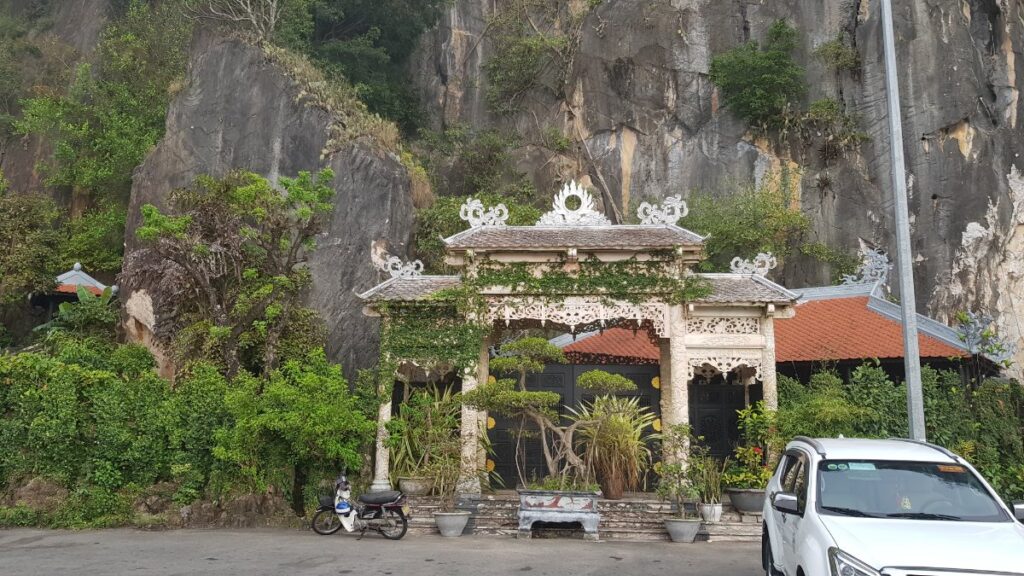
| Marble Mountains | Five marble hills of caves, shrines and viewpoints | 40,000 VND entry (~$1.55), elevator +15,000 VND; open 7am-5:30pm; ~10 min from the beach |
| Ba Na Hills | Record cable car, the 2018 Golden Bridge, a French-style village | ~1,000,000 VND/adult (~$38), now valid 3 days; ~45 min drive |
| Son Tra Peninsula | Jungle viewpoints, the giant Lady Buddha statue, and ~350 rare red-shanked douc langurs | Free; ~20 min. Watch for wild monkeys – do not feed them |
| Hoi An Ancient Town | UNESCO lantern-lit old town, now part of greater Da Nang | ~40 min by Grab; old-town ticket for the heritage houses |
And the food is the quiet winner. Da Nang is the home of mi quang (turmeric noodles with pork, shrimp and a crunch of rice cracker) and banh xeo, with fresh seafood everywhere and several Michelin-listed street stalls. A proper local bowl runs just 25,000-50,000 VND (about $1-2); a Western meal jumps to 200,000-300,000 VND ($8-12). Eating local here is one of the best-value experiences in Vietnam.
Where we send first-timers on night one: go looking for banh canh ca, the thick fish-noodle soup Da Nang does better than almost anywhere – it is the same local bowl Sonny Side featured in his Da Nang episode of the Best Ever Food Review Show. A bowl usually runs around 30,000 to 40,000 VND (a little over $1 USD): inexpensive, filling and unmistakably Da Nang. It is the kind of first meal that tells you why people wish they had booked more time here.
What it costs – a quick money snapshot
Da Nang is inexpensive by any Western standard, with the beach, the caves and the food all low-cost; the one big-ticket item is Ba Na Hills.
| Item | Price (VND) | Approx USD |
|---|---|---|
| Local meal (mi quang, com, pho) | 25,000-50,000 | $1-2 |
| Western restaurant meal | 200,000-300,000 | $8-12 |
| Marble Mountains entry (+ elevator) | 40,000 (+15,000) | ~$1.55 (+$0.60) |
| My Khe beach lounger, per day | 40,000 | ~$1.55 |
| Ba Na Hills cable car, adult | ~1,000,000 | ~$38 |
| Grab car across town | 40,000-70,000 | ~$1.50-2.70 |
| Hotel per night (mid-range to upscale) | – | under $60 to $200+ |
Figures checked in August 2026 at 1 USD = 26,000 VND, and may change.
Getting there is the easy part
Da Nang International Airport sits about 10-15 minutes from the beach and city centre – one of the shortest airport-to-sand transfers of any beach city in Asia.
You can fly in, drop your bag, and be swimming inside the hour. Grab and metered taxis are low-cost and everywhere, so no car rental is needed. Hoi An is roughly 40 minutes away by Grab or private car (there is no direct public bus that most visitors find usable), and Saigon is an 80-minute flight, which makes a Da Nang-plus-Saigon split week very doable.
Da Nang vs Hoi An vs Saigon vs Nha Trang – where to base
Base in Da Nang for the beach and day trips, in Hoi An for slow atmosphere, in Saigon for energy and food depth, and in Nha Trang only if a resort beach is your single priority.
- Choose Da Nang if you want a modern base with a real city beach, the widest spread of day trips, and the least planning friction. Best all-rounder for first-timers.
- Choose Hoi An if you want lanterns, tailors, riverside dinners and charm over convenience – and do not mind a quieter, more touristy bubble. Many people base in Da Nang and just spend evenings in Hoi An.
- Choose Saigon (Ho Chi Minh City) if you want buzz, history, and Vietnam’s deepest food and nightlife scene. See Ho Chi Minh City or Da Nang for that call.
- Choose Nha Trang only for a straightforward resort-and-islands beach break; it has less cultural range and fewer day trips than Da Nang.
Who should skip Da Nang
Skip Da Nang, or keep it to a single night, if you are a history-and-street-life traveller, a non-swimmer visiting in the rainy season, or someone who wants everything walkable from the hotel door.
Concretely, weight your trip elsewhere if: your priority is dense old-quarter atmosphere and museums (go Hanoi); you want big-city nightlife and grit (go Saigon); you are travelling in October-November and the beach is the whole point (the sea will likely be closed to swimmers); or you dislike using ride apps and want to stroll between sights. For everyone else – especially beach-plus-culture first-timers – it earns its three to four days.
How long to stay
Three to four days is the sweet spot: enough for beach time, one mountain-or-caves day, a Hoi An evening, and a food crawl, without running out of things to do.
Two days works if you only want the beach and one day trip. Five to six makes sense if you add My Son, the Cham Islands, or a slow Hoi An overnight. Our how many days in Da Nang guide breaks each version down hour by hour, and things to do in Da Nang covers the full sight list.
The easiest way to test whether Da Nang wins you over
The fastest way to know if Da Nang is your kind of city is to eat your way through it on night one, with someone who lives here.
That is exactly what our women-led, ao-dai motorbike food tours are built for: you skip the logistics and the language gap and go straight to the mi quang, the seafood, and the stalls that do not have English menus. The Da Nang Food Tour ($59) is our most-loved way in, and the Da Nang by Night tour ($35) pairs the food with the Dragon Bridge and the riverfront after dark – the bridge breathes fire and water on weekend nights (Saturday and Sunday, sometimes Friday) at 9pm for about 15 minutes. If Ba Na Hills or Hoi An is on your list, we also run a Ba Na Hills tour ($105) and a Hoi An coconut forest tour ($40).
FAQ: Is Da Nang worth visiting?
Is Da Nang worth visiting?
Yes, for a beach-plus-day-trips holiday. A swimmable city beach, the Marble Mountains, Ba Na Hills, the Son Tra Peninsula and Hoi An are all within about 40 minutes of a single base. It is less worth it if you want old-quarter history or nightlife, which Hanoi and Saigon do better.
How many days do you need in Da Nang?
Three to four days is ideal: enough for the beach, one caves or mountain day, and a Hoi An evening. Two days covers just the beach and one day trip; five to six lets you add My Son or the Cham Islands.
What is the best time to visit Da Nang?
February to May for stable, sunny weather, and April to August for the calmest, warmest sea – so April and May are the best overlap. Avoid October and November, when heavy rain, typhoons and street flooding are most likely and the beach often closes to swimmers.
Is Da Nang better than Hoi An?
They are different. Da Nang wins on beach, logistics and the range of day trips; Hoi An wins on atmosphere, lanterns and charm. Since the 2025 merger Hoi An is part of greater Da Nang, so many travellers base in Da Nang and visit Hoi An for evenings.
Is Da Nang good for a first trip to Vietnam?
Very. It is modern, safe, has clean air for Vietnam, a big international airport 10-15 minutes from the beach, and short distances – a low-stress base for first-timers who want sun plus a few big sights.
Is Da Nang safe for tourists?
Yes. It is one of Vietnam’s safest and least-hassle cities, with relaxed vendors and good beach lifeguard coverage. The main cautions are ordinary sea-current flags at the beach and wild monkeys at the Marble Mountains and Son Tra – do not feed or approach them.
Is Da Nang expensive?
No. A local meal is 25,000-50,000 VND (about $1-2), Marble Mountains entry is 40,000 VND (~$1.55), and a beach lounger is around 40,000 VND a day. The one splurge is Ba Na Hills at roughly 1,000,000 VND (~$38) per adult. Figures checked August 2026 at 26,000 VND to the dollar.
Is there much to do in Da Nang besides the beach?
Yes, but most of it is just outside the city rather than in it: Marble Mountains, Son Tra Peninsula and the Lady Buddha, Ba Na Hills, plus Hoi An and My Son as day trips. The central city itself is fairly light on walkable sights, which is why a base-plus-day-trips plan works best.
Do people speak English in Da Nang?
In the beach and tourist zones, enough to get by. A couple of streets inland it drops off quickly, so keep a translation app handy for local markets, taxis and family-run eateries.