

Is Saigon worth visiting? Yes – for most travellers, and more so in 2026 than ever, but not for everyone. Ho Chi Minh City has Vietnam’s deepest street-food scene, its most gripping war history, and two of the country’s best day trips (the Cu Chi Tunnels and the Mekong Delta) within reach. The honest catch: it is hot, loud, and traffic-choked, and it has no beach. Come for energy, food, and history – not for calm or coastline. Two to three days is the usual first visit, and the new Metro Line 1 has made getting around far easier than the city’s reputation suggests.
We ride this city almost every night, dropping foreign guests into food stalls and back lanes after dark. So here is the version we would give a friend, not a brochure: the specific reasons Saigon is worth your days, the specific reasons it might not be, and what changed in 2026 that makes the old “too chaotic for first-timers” warning out of date.
What changed in 2026: the Metro finally runs
The single biggest update is that Saigon now has a working metro, and it removes the number-one reason people used to dread the city. Metro Line 1 (Ben Thanh to Suoi Tien) opened in December 2024 and is fully operational in 2026: 19.7 km, 14 stations, English signage and ticket machines, and payment by QR code, contactless bank card, the HCMC Metro app, or cash. Fares run about 7,000-20,000 VND per trip (roughly $0.27-0.77 at 26,000 VND to the dollar), and trains are clean, air-conditioned, and blessedly quiet after the street.
For a first-timer this matters enormously. The line runs straight to Ben Thanh Market and the Saigon Opera House, so you can reach the historic core from Thu Duc without touching the traffic that scares people off. It does not cover everywhere yet – one line only – but it turns the intimidating “how do I even cross this city?” problem into a tap-and-go. Pair it with Grab for the gaps and you rarely need to argue a taxi fare again.
The honest case for and against
Saigon rewards a certain kind of traveller and wears down another kind fast. Rather than a soft “it overwhelms some people,” here is the blunt trade, side by side.
| What wins people over | What genuinely wears people down |
|---|---|
| The country’s deepest street-food scene – com tam, banh mi, hu tieu, seafood, and coffee culture on every corner | Heat and humidity year-round; March-May is punishing, and shade is scarce mid-afternoon |
| War history that lands hard: the War Remnants Museum, Reunification Palace, and the Cu Chi Tunnels day trip | Constant honking and engine noise – the soundtrack rarely stops, even at night |
| French-era landmarks in one walkable cluster: Notre-Dame Cathedral, the Central Post Office, the Opera House | Rush-hour scooter gridlock (roughly 7-9am and 4-7pm) that makes short hops slow |
| Real neighbourhood texture in Cholon (Chinatown), Binh Tay Market, and the hem (alleyway) lanes | No beach and little green calm – this is a working megacity, not a resort |
| Nightlife with range, from rooftop bars to the chaos of Bui Vien walking street | Construction, dust, and air pollution on bad days, especially in the dry season |
If that left column excites you more than the right column tires you, Saigon is worth it. If the right column is your idea of a bad holiday, read the next section before you book.
Who should come, and who should skip it
Come to Saigon if you are a food-first, city-curious traveller who likes being in the thick of things; skip it, or keep it to one night, if you came to Vietnam mainly for beaches, nature, or old-world quiet.
You will likely love Saigon if:
- Street food is a reason you travel, not an afterthought
- You find big, fast, modern Asian cities thrilling rather than stressful
- Modern history interests you and you want the southern side of the war story
- You want easy day trips (Cu Chi, the Mekong) without changing cities
You should shorten or skip it if:
- Beaches or scenery top your list – weight your trip toward Da Nang, Hoi An, or Phu Quoc instead
- Noise, heat, and crowds drain you quickly – two days is plenty; use it as an arrival point
- You want the more atmospheric, old-Vietnam feel – Hanoi and Hoi An deliver that better (more on Hanoi below)
- You are travelling with very young kids who tire in the heat – build in pool time and go slow
Being honest about the skip case is the point. Plenty of great trips give Saigon a single night as a landing pad and spend the rest on the coast, and that is a perfectly good plan.
How many days do you need?
Two to three days covers the city’s highlights plus one day trip; add a fourth if you want both the Cu Chi Tunnels and the Mekong Delta, or a slow, food-focused final day.
- One day (a stopover): the District 1 core on foot – Notre-Dame, Central Post Office, Reunification Palace, War Remnants Museum – then a street-food dinner. Enough to taste the city, not to know it.
- Two days: add Cholon (Chinatown) and Binh Tay Market, Ben Thanh, and a proper evening out. This is the sweet spot for most first-timers.
- Three days: add one big day trip – the Cu Chi Tunnels (half day) or the Mekong Delta (full day).
- Four days: do both day trips, or keep one day slow for markets, coffee, and neighbourhoods you liked.
Where you base yourself changes the feel a lot – see where to stay in Saigon for the district-by-district breakdown, and first time in Saigon for a smoother arrival.
Saigon vs Hanoi: which is worth your time?
If you can only pick one and you love food, energy, and modern history, choose Saigon; if you prefer old-world atmosphere, a compact walkable core, and cooler winters, choose Hanoi. They are genuinely different cities, not two versions of the same one.
| Saigon (Ho Chi Minh City) | Hanoi | |
|---|---|---|
| Feel | Fast, modern, expansive, commercial | Older, denser, more atmospheric |
| Food | Deepest and most varied street-food scene; sweeter southern flavours | Excellent too; more defined dishes (pho, bun cha), saltier northern style |
| Weather | Hot year-round; wet and dry seasons | Four seasons; a genuinely cool, sometimes cold winter |
| Big day trips | Cu Chi Tunnels, Mekong Delta | Halong Bay, Ninh Binh, Sapa |
| Getting around | Metro Line 1 plus Grab; sprawling | Mostly walkable Old Quarter; Grab |
Our honest take: many trips do both, flying between them in under two hours. If forced to choose, decide by day trip – the Mekong and Cu Chi pull you south, Halong Bay and the mountains pull you north.
Is Saigon expensive? A real daily budget
No – Saigon is one of Asia’s better-value big cities, and you can eat superbly for a few dollars. A quick mental trick: drop three zeros off a VND price and divide by about 26 to get US dollars. Here is what a real day costs at three levels.
| Item | Typical price (VND) | Approx. USD |
|---|---|---|
| Banh mi from a stall | 25,000-40,000 | $1-1.50 |
| Bowl of pho or com tam | 50,000-70,000 | $1.90-2.70 |
| Vietnamese iced coffee | 20,000-45,000 | $0.75-1.75 |
| Metro trip | 7,000-20,000 | $0.27-0.77 |
| Short Grab bike ride | 30,000-50,000 | $1.15-1.90 |
| War Remnants Museum entry | ~40,000 | ~$1.50 |
| Hostel dorm bed / night | 130,000-260,000 | $5-10 |
| Mid-range hotel room / night | 650,000-1,300,000 | $25-50 |
| Cu Chi Tunnels day trip | – | $15-20 |
| Mekong Delta day trip | – | $21-26 |
Rough daily totals: a backpacker can travel well on $25-40 a day, a comfortable mid-range traveller on $60-100 including a nice dinner and a tour, and you can spend far more on rooftop bars and design hotels if you want to. The airport is only about 6 km from the centre, so arrival transfers are low-cost too. Figures checked in August 2026 and may change.
When is the best time to visit?
The dry season (roughly December to April) is the most comfortable time to visit; the rainy season (May to November) brings short, heavy afternoon downpours but thinner crowds and lower prices.
| Season | Months | What to expect |
|---|---|---|
| Dry, cooler | Dec-Feb | Best weather, peak crowds and prices, festive around Tet |
| Dry, very hot | Mar-Apr | Sunny but scorching; start early, rest mid-afternoon |
| Rainy | May-Nov | Hot mornings, sharp 1-2 hour afternoon storms, lower-cost rooms, fewer tourists |
Do not let the rainy season put you off. The downpours are dramatic but brief, mornings are usually clear, and evening food tours slot neatly around them – the rain clears and the stalls come alive.
Is Saigon safe, and how do you get around?
Saigon is generally safe for tourists: the real risks are traffic and opportunistic phone- or bag-snatching from passing scooters, not violent crime. Keep your phone off the table at pavement cafes, wear a bag across your body, and be alert near Bui Vien at night.
The city’s famous learning curve is crossing the road. Do not wait for a gap that never comes – step off steadily, keep a predictable pace, and let the motorbikes flow around you. Between Metro Line 1, Grab bikes and cars, and your own two feet in District 1, getting around is far less daunting than the traffic photos suggest.
See the Saigon locals actually love
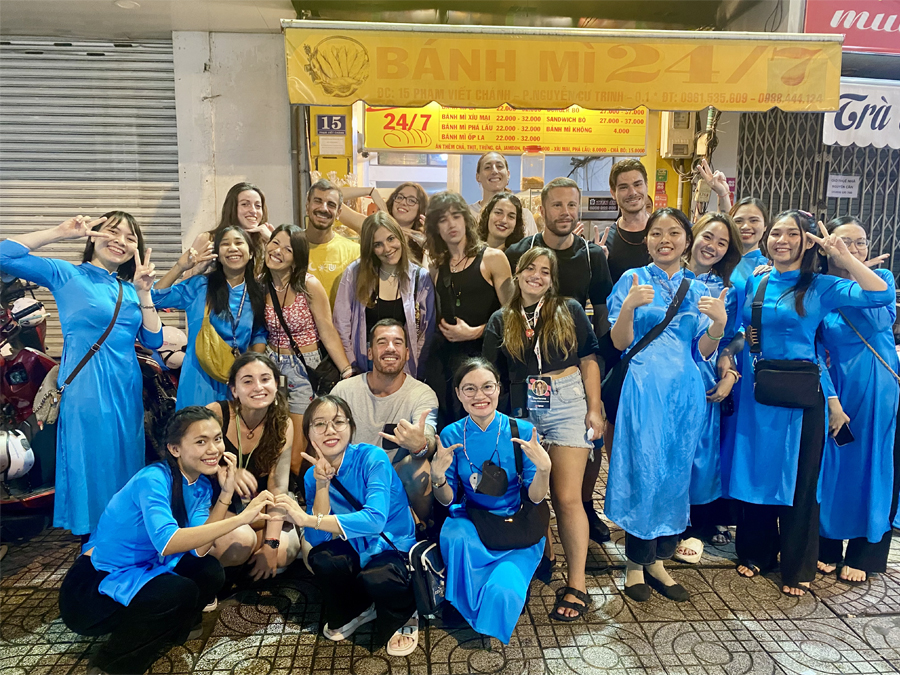
The fastest way to get past “big, hot city” and into the Saigon we love is to eat where locals eat, after dark, with someone who rides these lanes nightly. That is exactly what our women-led evening food tours are built for – the stalls, the hem alleyways, and the after-dark energy that make the case for the city better than any museum.
The moment that flips the skeptics: It is almost always a plastic stool at dusk – a cold drink or a bowl of something on a pavement corner while the whole city rides past a metre away. People arrive expecting sights; what wins them over is sitting inside ordinary Saigon life for an hour and realising they are part of it.
Our Saigon food tour ($59 USD) is the best single introduction – a few hours on the back of a bike turns the intimidating city into a map of flavours. If you want the nightlife angle, the Saigon by night tour ($39 USD) covers the same energy with less walking, and the Saigon city tour ($45 USD) folds in the daytime landmarks. Message us and we will tell you honestly whether Saigon fits the trip you are planning.
FAQ: Is Saigon worth visiting?
Is Ho Chi Minh City worth visiting?
Yes, for most travellers. Saigon has Vietnam’s deepest street-food scene, powerful war history, and easy day trips to the Cu Chi Tunnels and Mekong Delta. It best suits food-first, city-loving travellers; it is less rewarding if you came mainly for beaches or quiet.
How many days do you need in Saigon?
Two to three days covers the city and one day trip. Add a fourth if you want both the Cu Chi Tunnels and the Mekong Delta, or a slow final day for markets, coffee, and neighbourhoods.
Is Saigon or Hanoi better to visit?
Choose Saigon for food, energy, and modern history; choose Hanoi for old-world atmosphere, a walkable core, and cooler winters. Many trips include both, since they are only a short flight apart and feel genuinely different.
Is Saigon safe for tourists?
Generally yes. The main risks are traffic and opportunistic phone- or bag-snatching from passing scooters, not violent crime. Keep valuables secure, wear a bag across your body, and cross the road at a steady, predictable pace.
What is the best time of year to visit Saigon?
The dry season, roughly December to April, has the most comfortable weather but the biggest crowds and highest prices. The rainy season, May to November, brings short, heavy afternoon storms plus lower prices and fewer tourists. March to May is the hottest stretch.
Does Saigon have a beach?
No. Saigon is an inland megacity with no beach. The nearest coast is Vung Tau, about two hours away. If beaches are a priority, weight your trip toward Da Nang, Hoi An, or Phu Quoc instead.
Is Saigon expensive?
No, it is good value. Backpackers manage on about $25-40 a day, and a comfortable mid-range day with a nice dinner and a tour runs roughly $60-100. Street meals cost $1-3, and metro trips are under a dollar. Figures checked in August 2026 and may change.
How do you get around Saigon, and is there a metro?
Yes. Metro Line 1 (Ben Thanh to Suoi Tien) opened in December 2024 and runs in 2026, with English signage and tap-to-pay fares of about 7,000-20,000 VND. It reaches Ben Thanh Market and the Opera House directly. For everywhere else, the Grab app books low-cost bikes and cars without haggling.
Is Saigon worth visiting compared to the rest of Vietnam?
Saigon is the best base for southern Vietnam – food, history, and the Mekong – but it is a city experience, not a scenic one. Pair it with the coast (Da Nang and Hoi An) or the north (Hanoi, Halong Bay) for a balanced trip. Skip it only if your whole trip is beach- or nature-focused.